
By Wang Ling
Chief Research Fellow, New Generation Population Research Center
According to the latest 2025 national 1% population sample survey released by China’s National Bureau of Statistics, the average household size in China has now fallen to 2.52 persons, after dropping below 3 for the first time in 2014.
The continued shrinking of household size reveals a profound transformation: children are no longer a standard feature of Chinese families. At the same time, Chinese views on marriage, childbearing, and family are undergoing a fundamental shift — China is entering an era of low marriage and low fertility.
The Continuous Shrinking of Household Size
The decline in China’s household size has been ongoing for decades.
In 1990, the average Chinese household contained about 3.97 people. By 2000, it had fallen to 3.44; in 2010, to 3.10; and in 2013, it dropped below 3 people for the first time. After a brief rebound, the number continued declining, reaching 2.62 in 2020 and further falling to 2.52 in 2025.
Over 35 years, the average household size in China has shrunk by 36.5%.
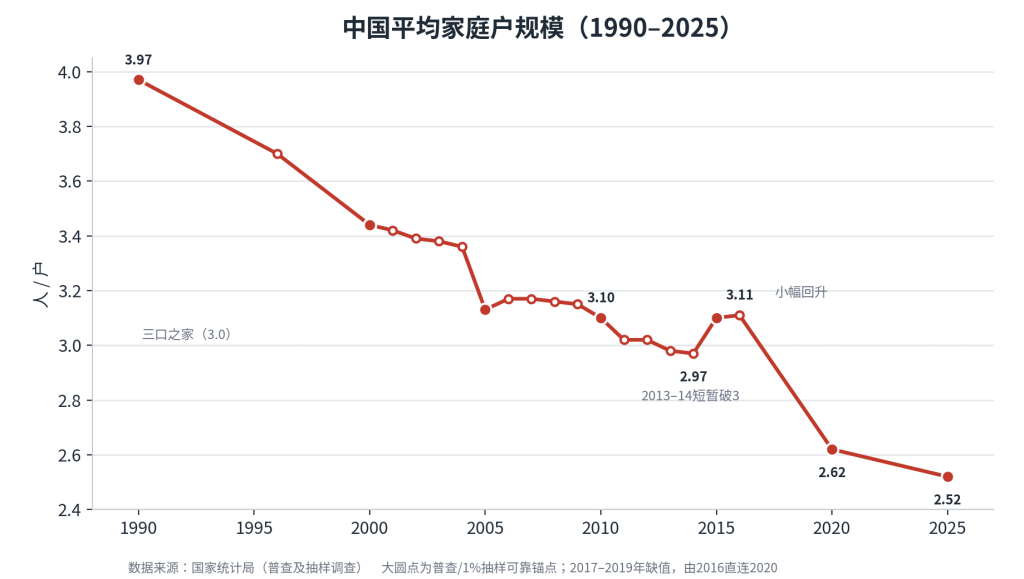
What is particularly noteworthy is that even after the “three-person family” ceased to be the norm, household size has continued to decline. Between 2020 and 2025 alone, it shrank by another 0.1 person.
A comparison of the data reveals that during those five years, China’s total population decreased by 6.33 million, while the number of households increased by 20 million. Roughly the same population is now spread across more and smaller households — young singles living alone, elderly empty-nesters, and childless young couples.
Behind this continued shrinkage lies the gradual relaxation of China’s birth policies. In 2016, China ended the one-child policy and introduced a universal two-child policy. In 2021, this was further expanded to a universal three-child policy.
Yet while fertility policies have become increasingly permissive, household sizes continue to shrink. This suggests that the key issue affecting fertility in China today is no longer whether people are allowed to have children, but whether they are willing to enter marriage, form families, and raise children at all.
From Low Fertility to Low Marriage and Low Fertility
The figure of 2.52 is not merely a demographic statistic; it is also a warning sign: China is moving from an era of low fertility into an era of both low marriage and low fertility.
The distinction is significant. Low fertility refers primarily to declining birth intentions and reduced childbearing caused by various internal and external factors. Low marriage and low fertility, however, means not only declining fertility intentions, but also a growing unwillingness to enter marriage and family life altogether.
Statistics show a sharp decline in marriage registrations in China over the past decade. In 2013, there were approximately 13.47 million marriage registrations nationwide. By 2024, that number had fallen to around 6.1 million couples. Meanwhile, the age of first marriage continues to rise, while non-marriage and single-person living arrangements become increasingly common.
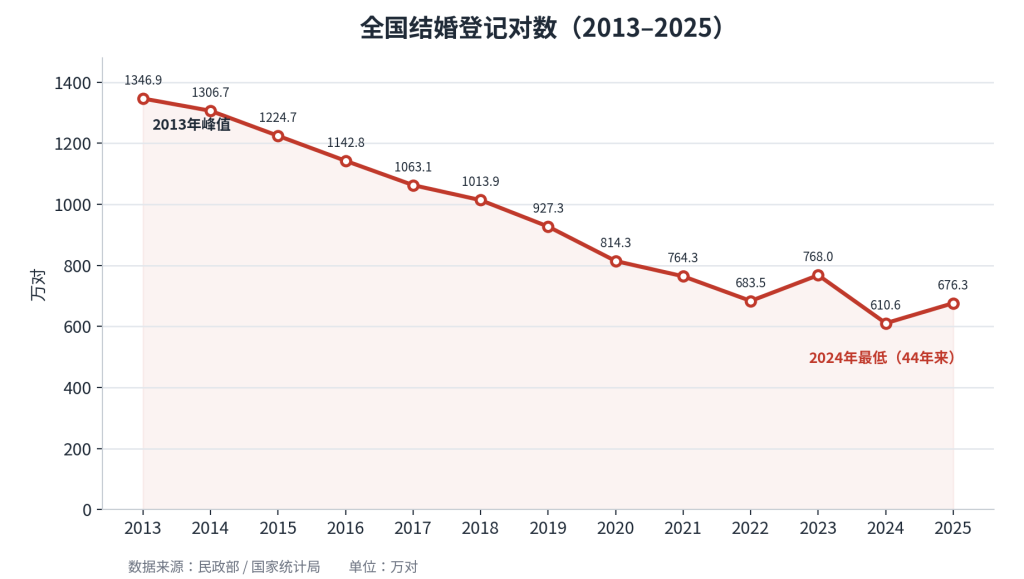
The decline in marriage has especially serious implications for births in China. Unlike many Western countries, China remains a society where childbearing is still overwhelmingly centered within marriage, with the proportion of births outside marriage remaining below 10%.
In many Western countries, marriage and childbearing have become partially decoupled. Around 40%–60% of children are born within non-marital cohabiting relationships, meaning that declining marriage rates do not necessarily lead to proportional declines in fertility. In China, however, a decline in marriage directly affects the number of births.
Considering the simultaneous decline in the number of women of childbearing age, the future reduction in births and the continued shrinkage of household size appear largely inevitable.
How Fertility Culture Has Been Reshaped
Several Chinese demographic research institutions have explicitly pointed out in recent reports that the decline in young people’s willingness to marry and have children has already moved beyond purely economic explanations. At its root lies a broader transformation in values, culture, and perceptions of family.
This is especially true for the roughly 200 million only children in China. Having grown up without siblings and within relatively small family structures, the idea of having only one child — or no children at all — has become easier to accept. Although fertility policies have changed, cultural inertia continues to exert a lasting influence.
The slogans of the family-planning era, such as “One child is best,” have gradually become internalized into the fertility and family values of many people. Among younger generations, remaining unmarried and childfree has increasingly become an openly discussed and socially conceivable life choice.
In recent years, surveys of university students’ attitudes toward marriage and fertility have shown similar trends. For example, a 2024 survey conducted by the Institute of Psychology at the Chinese Academy of Sciences found that 59.4% of university students believed “having children is not important,” while 51.8% believed “marriage is not important.”
“Getting married and having children,” once regarded as the default path of life, is increasingly becoming just one option among many. Children are no longer seen as a standard component of family life.
Rebuilding a Fertility Culture
In today’s era of low marriage and low fertility, how China can rebuild a culture that supports family formation and childbearing has become a question worth serious reflection.
What is meant by “rebuilding fertility culture” is not simply encouraging people to have more children. It first requires society to revisit deeper questions:
If a person can live independently, why is marriage still necessary?
If many people were wounded in their families of origin, why should they build families of their own?
If young people widely feel exhausted by life and uncertain about the future, how can childbearing once again become something hopeful and desirable?
These are not questions that statistics alone can answer.
But perhaps a truly “fertility-friendly society” must begin precisely here:
To make marriage no longer merely a source of responsibility and exhaustion, but a relationship of mutual support;
To make family no longer merely a site of pressure and sacrifice, but a space for human growth;
To make children no longer viewed primarily as costs, burdens, or competitive projects, but once again recognized as lives of unique value;
To ensure that those willing to have children are no longer trapped in impossible dilemmas, while those who choose not to have children are equally respected.
Therefore, rebuilding fertility culture requires not only institutional support in areas such as housing, education, childcare, employment, and women’s rights, but also a deeper renewal of values and meaning.
Childbearing can no longer rely solely on external pressure or economic incentives for its continuation. Society must rediscover marriage, family, and childbearing at the level of spiritual meaning and human purpose.
How China responds to this challenge will not only be reflected in future demographic statistics, but will also shape the future character of the society itself.